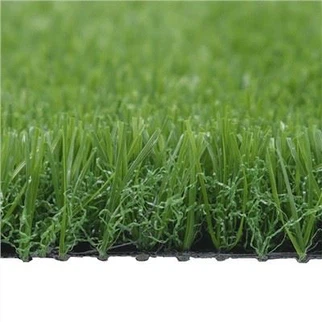
Can football field artificial turf be flame retardant?
Artificial turf for football fields was born in the United States in the 1960s, entered the Chinese market in the 1990s, and now enters every place in the world. Football field artificial turf is not only used in football fields, but also in rugby fields, tennis courts, hockey fields, volleyball courts, golf courses and other sports venues. It is also widely used in family environment courtyards, kindergarten construction, municipal greening, highway isolation belts, Leisure places such as airport runway auxiliary area.
From being only touched on the stadium to now being able to interact intimately in the room, the distance between the artificial turf of the football field and people has become closer and closer, so the coefficient of the artificial turf of the football field has become more and more obtained. It is important to note that the flame retardancy of artificial turf in football fields is a very important indicator. After all, the raw material of artificial turf in football field is PE polyethylene. If there is no flame retardant performance, if the result of fire accident is unpredictable, can artificial turf in football field really play the role of flame retardancy?
The main raw materials of football field artificial turf grass are polyethylene, polypropylene, and nylon. The commonly known "plastic" is a flammable substance. If the artificial turf of the football field does not have flame retardancy, if a fire accident occurs, it will lead to unpredictable results. Therefore, the flame retardancy of the artificial turf of the football field can be called the main reason for the coefficient of the artificial turf of the football field. Flame retardancy means that the artificial turf of the football field can be extinguished by itself after a fire, so that it is not easy to burn the entire artificial turf of the football field.
The basic principle of flame retardancy is actually to add flame retardants in the production of grass silk. Flame retardants were originally used to prevent fires, but later developed into artificial turf for football fields. The function of flame retardants is to effectively prevent the spread of flames. , to reduce the speed of the fire. Adding flame retardants to the artificial turf of a football field can also reasonably play a role in preventing the spread of fire. However, many artificial turf manufacturers in the market have omitted adding flame retardants in order to save costs, which has caused the artificial turf in football fields to pose a threat to human life, and it is also some hidden dangers of artificial turf in football fields. Therefore, when purchasing artificial turf for a football field, you need to choose a regular and reliable artificial turf manufacturer, and don't be greedy for cheap.
The lawn of the football field is slightly different according to the size of the field. The standard 5 cm monofilament lawn with a density of 10,500 clusters per square meter can be used for a larger field (generally more than 2,000 square meters). Fill with quartz sand + rubber particles, fill 4.5 cm, and leak 0.5 cm of grass silk. This kind of lawn paves the site with better elasticity and is more suitable for people with higher professional requirements. Generally, five-person or smaller venues can use non-filling lawns, (no-filling lawns refer to straight grass, this kind of lawn is thicker and denser, with a height of 3 cm to 4 cm, and can be laid directly On the site, there is no need to fill quartz sand + rubber particles and other auxiliary materials, and the laying is relatively simple).
After the artificial turf weaving is completed, it enters the adhesive process. Adhesive is a process after the artificial turf. The reason why there are problems such as low pull-out force and grass falling is mainly due to problems with the adhesive. The back glue is uneven, and there are obvious differences in thickness after drying. In severe cases, there will be grass shedding problems in the area where there are exposed grass threads in the future. In addition, the quality of the adhesive will also affect the pull-out force. The weaving process will directly affect the pull-out force and grass shedding of the artificial turf. At present, the weaving process at home and abroad is similar. As long as the quality of the base fabric is qualified, there will be no large-scale bottom cracks during the weaving process. The problem is generally solved in the process of making adhesive.
When paving simulated artificial turf, the ideal paving temperature should be between 10-25 degrees Celsius. Especially when laying simulated artificial turf in kindergartens, it is necessary to spread the simulated artificial turf to dry for a while in advance, and then start to lay the lawn neatly and start cutting, so that the simulated artificial turf can adapt to the temperature. Not only the temperature must be paid attention to, but also the cleanliness of the venue. The sundries should be cleared out of the venue, and the unevenness of the ground should be leveled. In addition, the paving of the simulated artificial turf will also involve the use of glue. If the glue can be drawn by hand after applying the glue, it means that the glue is ready to dry. At this time, the artificial turf can be bonded.