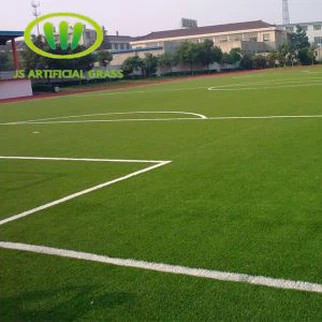
1. Check the entire turf field, whether the basic compactness and flatness meet the requirements, and then start to spread the artificial turf.
2. Measure the line on the entire site, measure the position of the course line and mark it, mark it with ink of different colors, and determine the laying direction and position of the artificial turf.
3. Start laying artificial turf: splicing the splicing belt on the turf joint surface and fixing it with steel nails. The steel nail head should not be raised, and the joint area should be overlapped and overlapd by more than 10cm.
4. Apply glue to the joint interface. Before the glue dries, cut and join the cut lawn so that each artificial lawn is tightly bonded.
5. After the laying is completed, it is necessary to carefully check whether the bonding of each joint area is smooth, and whether the artificial grass is firmly bonded. After the inspections meet the requirements, the next step can be carried out.
6. Cut off the green artificial turf at the position where the white line needs to be inserted, insert the joint belt, and apply glue on it, then insert the cut white artificial grass course line into the course line marked before the pavement. The position is bonded to the splicing tape.
7. Sprinkle quartz sand and rubber pellets according to the needs of the site. If you need to sprinkle quartz sand, pour quartz sand or black rubber particles into the sprinkler, push the sprinkler to fill the surface of the artificial turf with quartz sand or black rubber particles, and brush the quartz sand or black behind the sprinkler. The rubber particles are filled with quartz sand or black rubber particles.
8. Push the speed of the sprinkler to be uniform, not too urgent or too slow, to achieve uniform thickness.
9. After the quartz sand or black rubber particles are laid, check whether it is level and sufficient. If it is insufficient, it should be added as needed. Any impurities found in the pavement should be removed immediately to ensure the quality.
10. The quartz sand or rubber particles in the paving should be kept dry to facilitate the flow of quartz sand or rubber particles. After the quartz sand or rubber granules are finished, you can also use a hard brush or a light-loaded drag-type heavy brush, and brush back and forth to make the quartz sand drop fully dense.
11. After the completion of the laying, the inspection will be terminated.