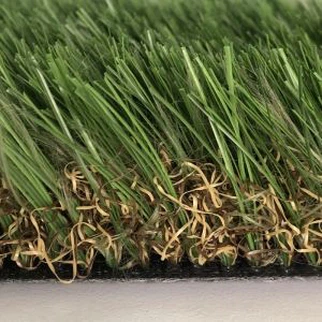
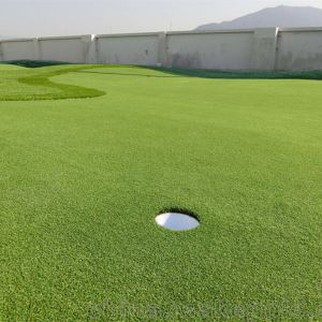
In the construction of artificial turf football fields, in addition to laying grass, the site also needs some auxiliary materials, such as quartz sand and rubber particles as fillers. After the artificial turf field is laid, firstly, the whole field should be filled with quartz sand, after being combed and leveled, then filled with rubber particles, and finally, the site will be combed and leveled to ensure uniform filling. Owners often ask, why do artificial turf football fields need to be filled with sand and particles? Below, the co-creation of artificial grass will give you a detailed answer.
FIFA described quartz sand as "stability infill" in the test report issued in accordance with its standards. Quartz sand can fill the gaps between the grass filaments. On the one hand, it can make the grass filaments stand upright, with distinct roots and a better rebound effect. The movement of the turf, in addition, to the filling of quartz sand can also prevent the grass from cracking due to friction between the grass filaments due to long-term stepping.
The rubber particles in the FIFA test report are "performance infill", that is, performance filler, as the name implies, to ensure its sports performance. The artificial turf itself also has a certain thickness and elasticity, but in order to meet the needs of sports and to be closer to the sports effect of natural grass, it is necessary to further fill with rubber particles to increase the resilience of the field and absorb vibration to prevent injuries to athletes. Sometimes in order to further achieve cushioning, another layer of cushioning pad is needed under the lawn. In fact, there are many filling materials for granules. At present, rubber granules are mainly used in China, and other materials such as cork are also used in foreign countries for filling, as long as sufficient sports performance can be guaranteed.
According to the FIFA standard, the height of the bare grass should reach more than 1/3 of the grass height, which requires that the filler should not be too much, but if the filler is too small, the sports performance will not meet the standard. Therefore, in order to meet the FIFA standards, artificial turf products of different types and parameters require different ratios of quartz sand and rubber particles, which requires manufacturers to try and study in the laboratory. At present, the co-created artificial grass has hundreds of different products that have passed the FIFA standard