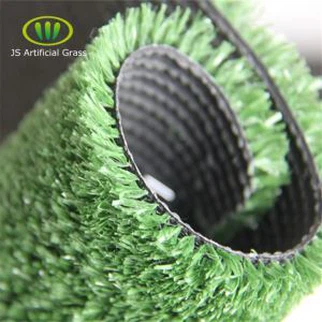
Artificial grass is a chemical product with grass-like synthetic fibers implanted on the woven base fabric and coated on the back with a fixed action coating. Widely used in sports and leisure places. Chemical composition: The raw materials are mainly polyethylene (PE) and polypropylene (PP), but also polyvinyl chloride and polyamide. The leaves are green with imitation of natural grass and need to be added with UV absorber.
Polyethylene (PE): It has a softer feel, closer to natural grass and sports performance, and is widely accepted by users. It is the most widely used artificial grass fiber raw material on the market. Polypropylene (PP): The grass fiber is relatively hard, and is generally suitable for tennis courts, playgrounds, runways or decorations. The wear resistance is slightly worse than polyethylene.
Nylon: It is the earliest raw material of artificial grass fiber and belongs to the first generation of artificial grass fiber. Material structure: Artificial grass consists of 3 layers of materials. The base layer is composed of a compacted soil layer, a crushed stone layer and an asphalt or concrete layer. The foundation layer needs to be solid, non-deformable, smooth and impervious to the surface, that is, a general concrete site.

Due to the large area of the hockey field, the foundation layer must be properly handled during construction to prevent subsidence. If the concrete layer is paved, expansion joints should be cut after the concrete is cured to prevent thermal expansion deformation and cracks. Above the base layer is a buffer layer, usually composed of rubber or foam. The rubber elasticity is moderate and the thickness is 3 ~ 5mm. The cost of using foam plastic is low, but the elasticity is poor, the thickness is 5 ~ 10mm, too thick lawn is too soft, and it is easy to sag; too thin and lack of elasticity, can not play a buffering role. The buffer layer should be firmly pasted on the base layer, generally with white latex or all-purpose adhesive. The third layer, also the surface layer, is the turf layer. According to the manufactured surface shape, there are downy turf, circular curled nylon silk turf, leaf-shaped polypropylene fiber turf, nylon woven permeable turf, etc. This layer must also be glued to rubber or foam with latex. It must be fully glued during construction, and pressed tightly in sequence, without wrinkling. In foreign countries, there are two common types of turf layer: 1. The leaf-shaped fibers of the turf layer are thin, only 1.2 ~ 1.5mm; 2. The turf fibers are thick, 20 ~ 24mm, which are filled with quartz almost to the top of the fiber.